Our Mission is to unite prevention advocates in Washington State to create safe and healthy communities by preventing substance misuse and violence.

Prevention Headlines
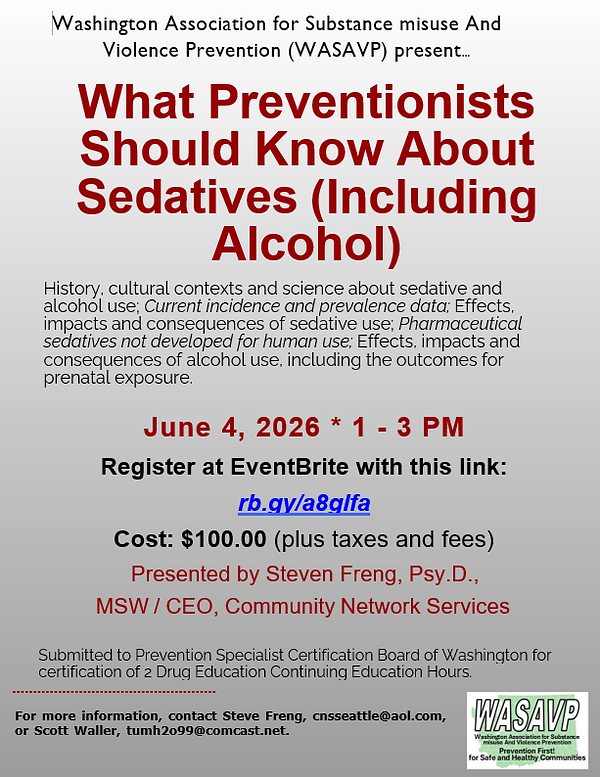
WASAVP Announces New Offering in "What Preventionists Should Know About Pharmacology" Series
Why Is Ongoing Learning Important for Prevention Providers?
Prevention providers have a responsibility to grow professionally in both knowledge in knowledge in skills in order to be current about developing trends and techniques so they can effectively respond to new challenges. Consider these two examples of effective professional growth among prevention providers:
Fentanyl. Five years ago, few people in Washington State were concerned about fentanyl. Since then, fentanyl has become a major problem as overdose deaths rose quickly. To respond, prevention providers, emergency responders, and communities had to learn more about the drug and adopt new strategies.
Prevention efforts expanded
to include partnerships with
law enforcement, fire, and
ambulance services. Providers
also began using harm
reduction approaches, such as
helping to distribute naloxone
to reverse overdoses, instead of
focusing only on preventing substance use. And prevention providers needed to expand their knowledge and skills to respond to the rapidly expanding fentanyl problem.
In 2024, the state saw its first decrease in overdose deaths in many years. That success happened because policymakers increased funding for naloxone and treatment, emergency responders improved their response to fentanyl-related health crises, and prevention providers educated communities about fentanyl’s risks.
Synthetic THC. In 2023, Washington passed a law requiring all synthetic THC products derived from hemp to be sold exclusively in licensed cannabis stores, where customers must be at least 21 years old. This law closed a loophole created by the 2018 federal Farm Bill, which had allowed synthetic THC products to be manufactured, sold, and distributed online with minimal regulation.
Before the law passed, prevention
providers, community leaders,
and policymakers had to learn
about these products and the
risks they posed to young people.
They also built partnerships that
helped move the legislation
forward. Washington’s approach
was later adopted by other states.
Although Washington’s law prohibited the manufacture of synthetic THC products, companies in other states continued to produce these substances and sell them online, allowing many products to reach youth in Washington. In response, Congress closed the hemp loophole in the 2025 Farm Bill, ending most online sales of synthetic THC products and strengthening protections for young people.
Staying informed about emerging drug use trends—and how to respond to them—is an ongoing responsibility for prevention providers. These examples highlight the importance of remaining up to date and continually building knowledge and skills so effective solutions can be developed as new challenges arise.


WASAVP's "What Preventionists Should Know About Pharmacology" learning opportunities.
WASAVP created and delivered a “What Preventionists Should Know About Pharmacology” training series in response to prevention and public health professionals who reported difficulty finding pharmacology trainings designed specifically for prevention work.
So far, WASAVP has developed trainings on cannabinoids, opioids, and stimulants. A fourth online training focused on depressant drugs, including alcohol, is planned for Spring 2026. WASAVP has also identified two additional training topics for 2026–2027:
-
Legal substances, such as kratom and nitrous oxide, that can cause impairment, injury, or death
-
The question of where harm reduction ends and prevention begins
Recordings of these trainings are now available for purchase for a small fee, allowing prevention professionals to earn required continuing education hours (CEHs). Registration fees help support WASAVP’s statewide prevention efforts.
Are There Specific Training Requirements for Prevention Providers?
Certified Prevention Professional (CPP)
Prevention providers funded through the Community Prevention and Wellness Initiative (CPWI) by the Health Care Authority (HCA) are required to earn a Certified Prevention Professional (CPP) certification. This certification demonstrates that providers are trained to use evidence-based strategies to promote healthy behaviors, reduce risks such as substance use and violence, and strengthen community health.
The CPP credential adds credibility, ensures consistent quality, supports professional growth, and confirms that providers meet high ethical and professional standards. CPPs share a common foundation of knowledge and skills, regardless of where they work.
CPP Training Requirements - To earn certification, providers must complete 120 continuing education hours, including at least 60 hours in the past year. These hours include:
-
14 hours: Drug pharmacology and/or harm reduction
-
6 hours: Prevention ethics
-
5 hours: Equity education
-
45 hours: Substance prevention education
-
50 hours: General prevention education
These requirements outline the essential knowledge every prevention provider should have. Many of the required hours can be completed through free online trainings, which are listed later on this page.
Pharmacology-for-prevention training
Of the training subjects on the CPP list, training hours in drug pharmacology and harm reduction are more difficult to find. WASAVP chose to offer additional prevention-specific pharmacology trainings after many prevention providers reported difficulty finding pharmacology coursework that met CPP application requirements.
With the WASAVP prevention-focused pharmacology training, there are now 14.5 Continuing Education Hours (CEH) available easily to Washington prevention and public health professionals. Completion of all the trainings in the following list is sufficient to meet the CPP application requirements.